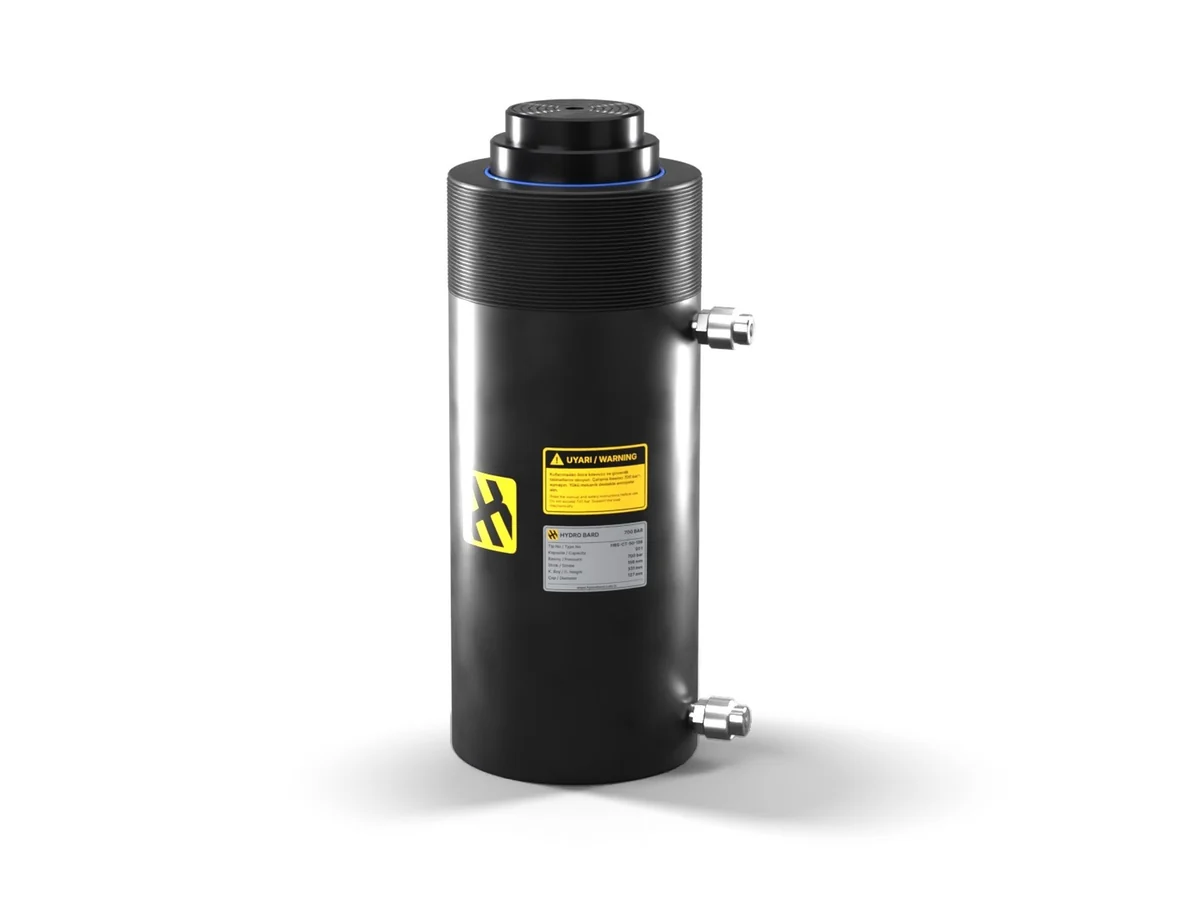
What is a double-acting hydraulic cylinder?
It is a cylinder type with independent hydraulic lines and effective areas for both the push and pull directions, where the return stroke is also controlled hydraulically. The HBS-CT series is a hydraulic cylinder/jack series that operates on this principle.
What capacity and stroke options does the HBS-CT series offer?
It covers a 30–95 ton push capacity range across 6 models; stroke options range from 156 mm to 368 mm. Full dimensions and pull capacities are listed in the model table.
What is the difference between a double-acting and a single-acting hydraulic cylinder?
In single-acting cylinders, the piston returns via a spring mechanism; in the double-acting HBS-CT series, both the forward and return strokes are pressure-controlled through separate hydraulic lines, which provides more precise and repeatable positioning.
What pump and connection standard does the HBS-CT work with?
It operates with a 700 bar class hydraulic pump, using a 2× 3/8″ NPT/F connection standard with separate lines for the push and pull directions.
Why do the push and pull capacities differ in the HBS-CT series?
Because the piston rod reduces the effective area in the push direction, pull capacity is lower than push capacity; for example, in the HBS-CT-95 model push is 95 t / 933 kN while pull is 435 kN. Full values are listed in the model table.
In which sectors/applications is the HBS-CT series used?
It is used in applications requiring bidirectional controlled force, such as heavy maintenance and repair, press/die removal-installation, controlled assembly-disassembly, large equipment positioning, and industrial plant maintenance.
How much does an HBS-CT model weigh?
Weight varies by model: the smallest model (HBS-CT-30-209) weighs approximately 6.7 kg, and the largest model (HBS-CT-95-333) weighs approximately 34.5 kg.
What material is the HBS-CT series made from?
It is manufactured with a 7075-T6 aluminum alloy, hard anodized body, providing durability suited to the double-acting hydraulic construction.
How do I choose the right HBS-CT model?
Determine the required push and pull force and stroke distance, then select the appropriate code based on the capacity and stroke values in the model table; you can also get a recommendation through the technical quote form.
How is the HBS-CT series maintained?
Periodic visual inspection and seal replacement are recommended for both hydraulic lines; because it uses a hydraulic return system, service steps differ from spring-return models.
What is the difference between the HBS-CT and other HBS series?
What sets the HBS-CT apart from the other series is its hydraulically controlled bidirectional (push-pull) operating principle. The HBS-GA is for general-purpose use, the HBS-DP for low-profile applications, and the HBS-DL for center-hole (hollow plunger) applications.
Is the HBS-CT series also referred to as a hydraulic jack?
Yes. In field terminology it is also referred to as a "double-acting hydraulic jack"; in technical documentation, the term "double-acting hydraulic cylinder" is used.
Do you provide maintenance/repair service and spare parts support for HBS-CT series double-acting hydraulic cylinders?
Yes. We handle maintenance and repair for HBS-CT series cylinders in-house — send us your unit and we'll inspect it and manage the repair process. We also manufacture original spare parts (seals, pistons, etc.) on request for the models we produce; we don't maintain a separate parts catalog, but you can contact us directly for the part you need.